


Yandex Weather & Rain Radar
Direct Cursus Computer Systems Trading LLC
I installed Yandex Weather & Rain Radar expecting a straightforward weather app, and that is mostly what it is: a practical way to check current conditions, follow rain on a radar map, read forecasts, and keep weather information close through alerts, maps, and widgets. It is free, rated for Everyone, and developed by Direct Cursus Computer Systems Trading LLC. My experience was useful overall, but it also showed why weather apps can feel unreliable when location settings, notification controls, or map loading do not behave as expected.
The app has a 3.1 average from around 831 thousand ratings and has passed 50 million installs. Those numbers suggest that it is familiar to a large Android audience, although the middling average is also a sensible reminder not to expect a flawless experience on every phone or in every location. I would recommend trying it if you want one app that combines a forecast with radar and alerts, but I would not treat it as the only source for decisions where conditions can change quickly.
Where the first problems usually appear
The first point of friction is often the forecast location. A weather app needs to know where you are, and a phone may offer several choices about location access. If the app opens with a city that is not yours, shows an old place, or keeps asking for access, the problem may be the phone’s location setting rather than the forecast itself. I found it more useful to check the selected location before judging the quality of the predictions.
Another common stumbling block is the radar map. A radar view is more demanding than a simple temperature screen because it has to load map imagery and weather movement together. On a weak connection, the base map may appear while the rain layer takes longer, or the display may remain incomplete. Closing and reopening the map can help, but switching between mobile data and Wi-Fi is also a sensible test before assuming that the feature is broken.
Alerts can create a different kind of confusion. Some people install a weather app specifically for rain warnings, then discover that notifications are disabled at the system level or restricted by battery-saving settings. Others receive too many messages because the alert controls are broader than they expected. I recommend checking both the app’s own alert choices and the phone’s notification settings. Changing only one of them may not produce the result you want.
Related News

Instagram Is No Longer a Photo App. It Is an Attention Engine

Microsoft Teams Mobile: When Collaboration Becomes Navigation

How the NFL App Adapts to Android and iOS Updates

Temu: Elevate Your Shopping Experience to Billionaire Status

Why Traffic Rider Works Best as a Precision Reflex Game

How Google’s Find Hub Transforms Everyday Searches
Widgets are convenient, but they are also affected by the launcher and the phone’s background rules. If a widget does not refresh, disappears after a system cleanup, or shows stale information, reinstalling the entire app is usually not my first choice. I would remove and add the widget again, confirm that the app is still installed normally, and check whether the phone is limiting background activity. The widget is a shortcut to the app’s information, not an independent forecast engine.
There is also a practical expectation issue. A rain radar can show the recent direction of precipitation more clearly than a daily forecast, but it does not make distant weather perfectly predictable. A narrow shower can develop or weaken between updates, and local conditions can differ across a short distance. I use the radar to answer “is rain approaching my route?” rather than “will every minute of my afternoon stay dry?”
What to check before blaming the forecast
My first setup check is the location name. I look at the city or area displayed in the app and compare it with where I actually am. This matters especially when traveling, commuting between nearby towns, or using a phone that has remembered a previous location. If the location is wrong, every later judgment about temperature, rain, and alerts becomes unfair.
Gallery
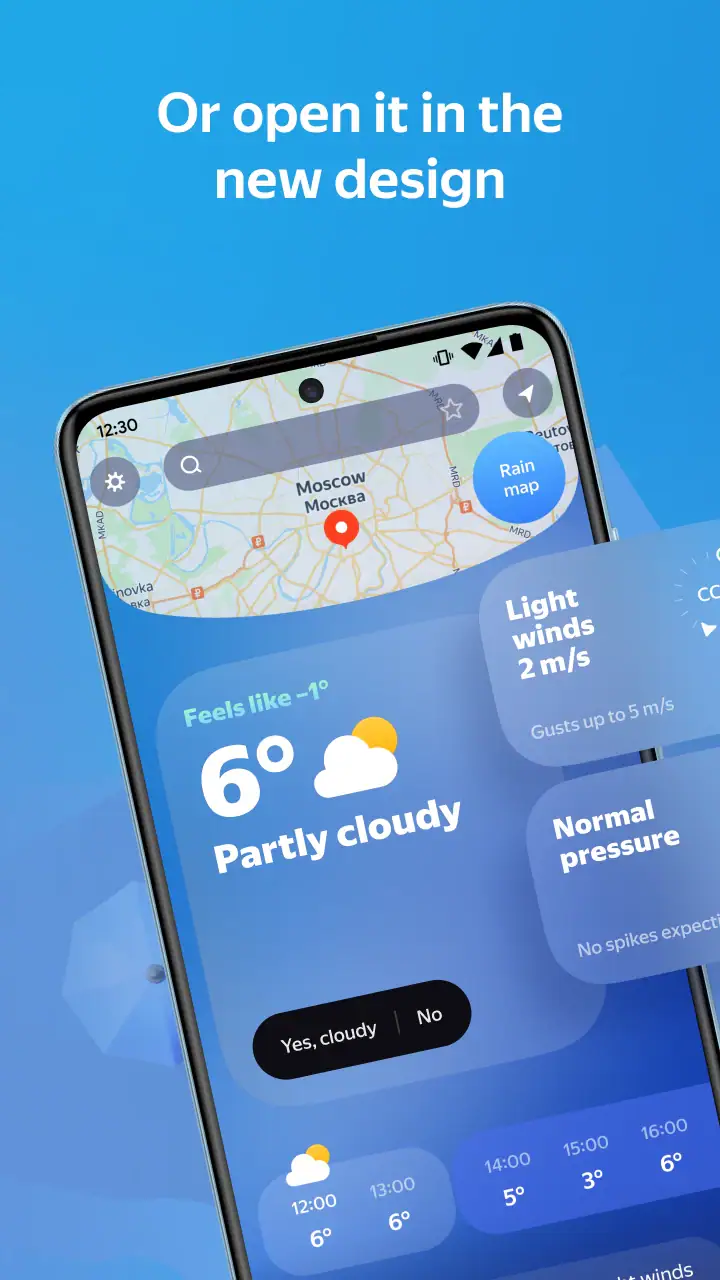
Next, I check whether the phone is online in the way I expect. A page that loads on Wi-Fi but not on mobile data points toward a connection or carrier setting. A map that loads only after a delay may simply be waiting for a larger amount of information. I avoid repeatedly tapping the same control, since that can make a slow response look like several failed requests.
The app supports Android from version 8.0 onward, and it is currently listed as version 26.6.10. On an older device, I would first make sure the operating system and the app are compatible with the phone’s normal update process. On a newer device, I would still check whether the app itself is current before troubleshooting unusual behavior. Version checks are simple, but they prevent spending time on a problem that an ordinary update may already address.
For a clean daily setup, I would begin with one main location, then add only the places I genuinely follow. A long list of cities can make the app less convenient because the information you need gets buried among places you rarely visit. Keeping a home location, a workplace, and a frequent travel destination is more useful than treating the app as a directory of every place you might visit someday.
I also decide in advance how I want to use alerts. If I need a quick warning before leaving home, notifications are useful. If I only want to check the forecast manually, I keep alerts limited so the app does not become background noise. The right setting depends on your routine, and a weather warning has value only if you notice it and understand which location it refers to.
The widget deserves its own setup decision. A small widget is helpful when I need a glance at conditions without opening the full app. A larger layout may be more useful if I want several pieces of information visible at once, but it also takes more home-screen space. I would place it where it is easy to see before leaving, then open the app itself when I need the radar or a more detailed view.
Recovering a weather-checking routine when something fails
When the app appears stuck, I use a simple recovery order. First I confirm the selected location and connection. Then I leave the affected screen and open it again. If the issue is limited to the radar, I test the regular forecast; if the forecast works but the map does not, that points toward a map-loading problem rather than a complete app failure.
If a widget is stale, I compare it with the information inside the app. A refreshed in-app screen tells me that the widget needs attention, while an equally stale app screen suggests that I should look at connectivity, location, or the service response. This comparison is more informative than immediately deleting data, because it tells me which part of the experience is actually failing.
For notifications, I send myself through a basic checklist: the desired location is selected, alerts are enabled in the app, notifications are allowed by the phone, and the app has not been restricted so aggressively that it cannot update in the background. I do not assume that a missing alert proves the forecast was wrong. It may simply mean the message was blocked, delayed, or configured for another location.
Restarting the app is reasonable when a screen has clearly stopped responding. Restarting the phone can also clear temporary system issues, especially after changing location or notification settings. I reserve more disruptive steps, such as clearing app data or reinstalling, for situations where the basic checks do not help, because those actions can remove saved preferences and force me to configure the app again.
A useful recovery habit is to compare the radar with what is happening outside. If the map suggests rain nearby but the sky is clear, I wait briefly and check whether the radar movement matches the direction of travel. If the app shows no rain while a shower is already falling, I look at the update state and connection before concluding that the service has failed. Weather information is time-sensitive, so a single screen is not always enough evidence.
For a commute, I use the app in two stages. Before leaving, I check the broader forecast and the radar around the route. During the journey, I avoid constantly refreshing it, since that adds little value when conditions are stable. If the sky changes, I check again and compare the map with the visible weather. This approach saves battery and attention while still making the radar useful.
When the app is not the cause
Weather apps are often blamed for conditions that are actually caused by the phone or the network. A device with a weak signal can receive text more easily than a map layer, making the radar appear broken even though the rest of the internet seems usable. A restrictive battery mode can delay background updates, and a launcher can interfere with how a widget refreshes. These are not unusual edge cases; they are part of using a live information app on a mobile device.
Location accuracy can also vary around tall buildings, indoors, or in areas where the phone has trouble obtaining a strong position. If the app keeps showing a nearby district instead of the exact street, I focus on whether the forecast is relevant to the wider area rather than expecting street-level precision. For local outdoor plans, I treat the displayed location as something worth checking, not as an invisible guarantee.
There is a second limitation that belongs to weather forecasting itself. A daily forecast is useful for planning clothes, errands, and travel, but it cannot describe every small change in a neighborhood. Radar is especially valuable for short-term rain awareness, yet its usefulness depends on how current the image is and how quickly the weather is moving. I would still look outside and use official emergency instructions when severe conditions are involved.
This is also why I would not rely on this app alone for aviation, mountain travel, water activities, or emergency preparation. In those situations, a dedicated local authority or specialist service may provide the more appropriate information. Yandex Weather works best as an everyday planning tool, not as a replacement for professional or official warnings.
Compared with a basic phone weather widget, this app offers a more deliberate weather workflow because the radar, maps, alerts, and forecast views are available together. Compared with a specialist radar service, it may feel less focused if your only interest is precipitation movement. I prefer it when I want a balanced overview, while I would choose a specialist tool when radar detail is the central reason for opening an app.
The rating also affects my recommendation. A 3.1 average is not a reason to dismiss the app, especially because weather experiences depend heavily on region, phone settings, and expectations. Still, it tells me to install it with realistic patience. If a user wants a perfectly silent widget, instant map loading everywhere, or highly specialized forecasting, this may not be the best match.
Who will get the most from it
I think the strongest audience is people who want more than a temperature number but less complexity than a specialist weather platform. A commuter can use the radar before walking to a station. A parent can check whether a playground visit is likely to be interrupted. Someone planning a short bike ride can compare the wider forecast with the movement of nearby rain. These are small decisions, but they are exactly where a combined forecast and radar app earns its place.
It is also useful for people who like information visible without opening a full forecast every time. A widget can provide a quick glance, while the main app remains available for a closer look. I would keep the widget for routine awareness and use the radar only when timing matters. That separation keeps the home screen simple and avoids turning every weather check into a long browsing session.
Travelers may appreciate the ability to follow another location, but I would configure it before the trip rather than while rushing through an airport or train station. Setting the destination in advance gives me a better chance of noticing a wrong location or an unwanted alert. Once there, I can use the radar for immediate plans and the broader forecast for the next day.
On the other hand, users who dislike notifications, widgets, or location setup may find the app more effort than a minimal weather screen. People who need highly specialized warnings should also look elsewhere. The free price makes experimentation easy, and the Everyone age rating makes it broadly accessible, but neither fact changes the need to choose a weather tool that fits the seriousness of your plans.
My practical verdict after using it
Yandex Weather & Rain Radar is a useful middle-ground weather app. I like the way it brings ordinary forecasts together with a radar map, alerts, maps, and widgets, because that covers most of my daily questions without requiring several separate tools. Its best feature is not any single screen; it is the transition from “what is the weather?” to “should I leave now, wait, or take another route?”
My main advice is to set up the location carefully, test notifications before depending on them, and treat the widget as a convenience rather than the complete product. If the radar is slow, check the connection and compare it with the regular forecast. If the information seems wrong, verify the location and remember that nearby weather can change quickly. These small habits prevent most of the frustration I experienced during testing.
The app first appeared on December 24, 2010, and its current version is 26.6.10, so it is an established product rather than a new experiment. I would install it for everyday planning, especially if rain timing matters to my routine. I would skip it only if I wanted a specialist radar tool, extremely minimal weather information, or a service designed specifically for serious outdoor and emergency decisions.
In the end, I see it as a sensible free option with useful breadth and some setup friction. Its real strength is practical context: forecast information becomes more helpful when I can check the map, follow a location, and decide what to do next. As long as I keep its limitations in mind and do not confuse a forecast with a guarantee, it is an app I would comfortably recommend to a friend who wants a fuller daily weather check than the default phone widget provides.
FAQs for Yandex Weather & Rain Radar
What features does Yandex Weather & Rain Radar offer?
Yandex Weather & Rain Radar provides real-time weather updates, detailed forecasts, and interactive rain radar maps. Users can access hourly and daily forecasts, weather alerts, and even track storm movements. The app also offers personalized weather notifications to help you plan your day effectively, making it a comprehensive tool for weather insights.
Is Yandex Weather & Rain Radar accurate in forecasting?
Yandex Weather & Rain Radar is known for its high accuracy, utilizing advanced meteorological data and algorithms. The app provides precise short-term and long-term forecasts by analyzing local weather stations and global weather models. Users often praise its reliability, especially for immediate weather changes like sudden rain showers.
Does Yandex Weather & Rain Radar support multiple locations?
Yes, the app allows users to track weather conditions for multiple locations. This feature is particularly useful for those who travel frequently or want to keep an eye on the weather in different cities. You can easily switch between locations and even set preferred locations for quick access to weather updates.
Is Yandex Weather & Rain Radar free to use?
Yandex Weather & Rain Radar is free to download and use. It offers a range of features without any cost. However, there may be in-app advertisements. Users can choose to upgrade to a premium version, if available, to remove ads and possibly unlock additional features for an enhanced experience.
How user-friendly is the Yandex Weather & Rain Radar app?
The app is designed with user experience in mind, featuring a clean, intuitive interface. Navigation is straightforward, allowing users to quickly access weather information and radar maps. It caters to both novice users and weather enthusiasts, providing a smooth and engaging experience while delivering detailed weather insights.
Pros
- Accurate weather updates with real-time alerts.
- User-friendly interface with easy navigation.
- Detailed rain radar for precise tracking.
- Customizable notifications for specific conditions.
- Global coverage with local weather insights.
Cons
- Limited features in offline mode.
- Ads can be intrusive for some users.
- Some features require a stable internet connection.
- Occasional delays in weather updates.
- Interface may be overwhelming for new users.


